Part of the complete guide: How to improve your archery score
You miss by an angle, not by centimetres: a tenth of a degree is about 3 cm at 18 metres and about 12 cm at 70. So shoot a dozen arrows at 20 metres and a dozen at 40, and measure the group on both axes. If it roughly doubles, the cause is angular and you can train it at short range. If it grows well beyond double or turns oval, check wind, drag and tuning before your technique.
It happens to everyone, at every level: at 18 metres your group fits in a fist, then you move back to 50 or 70 and it looks like somebody else was shooting. The instinctive reaction is to think you have two techniques, a good one for short range and a poor one for long, but that is almost never the case: the technique is the same, and distance simply puts it under magnification.
Understanding how your group grows with distance, though, is worth more than consolation: it is a diagnosis, since the causes fall into two families that grow in different ways, what comes from the shot growing in a straight line with the metres and what comes from the air and the tuning growing faster. Comparing your group at two distances is the simplest way there is to tell them apart, and it requires no equipment beyond a tape measure.
The error is born as an angle, not as centimetres
The starting point is something easily forgotten: when you miss, you do not miss "by ten centimetres", you miss by an angle. The arrow leaves your hand pointing in a direction slightly different from the right one, and that angle stays the same for the whole flight: it is the metres that turn it into centimetres. The farther the arrow travels, the wider that angle opens.
The consequence is a rule of disarming simplicity, elementary geometry rather than a theory: for the same angular error, the miss on the target grows in proportion to the distance. A tenth of a degree of deviation is worth about 3 centimetres at 18 metres, whereas the same tenth of a degree, at 70 metres, is worth about 12 centimetres. You did not get four times worse between the two lines: it is the exact same error, seen from farther away.
These angular errors come from everything that belongs to the shot and the aim: a release that is not identical, an anchor that shifts by a millimetre, a bow hand that rotates, an aim that settles in a slightly different spot. These are the "human" errors, and they carry a precise signature: they grow with distance proportionally, doubling when the distance doubles.
The official target sizes already know this
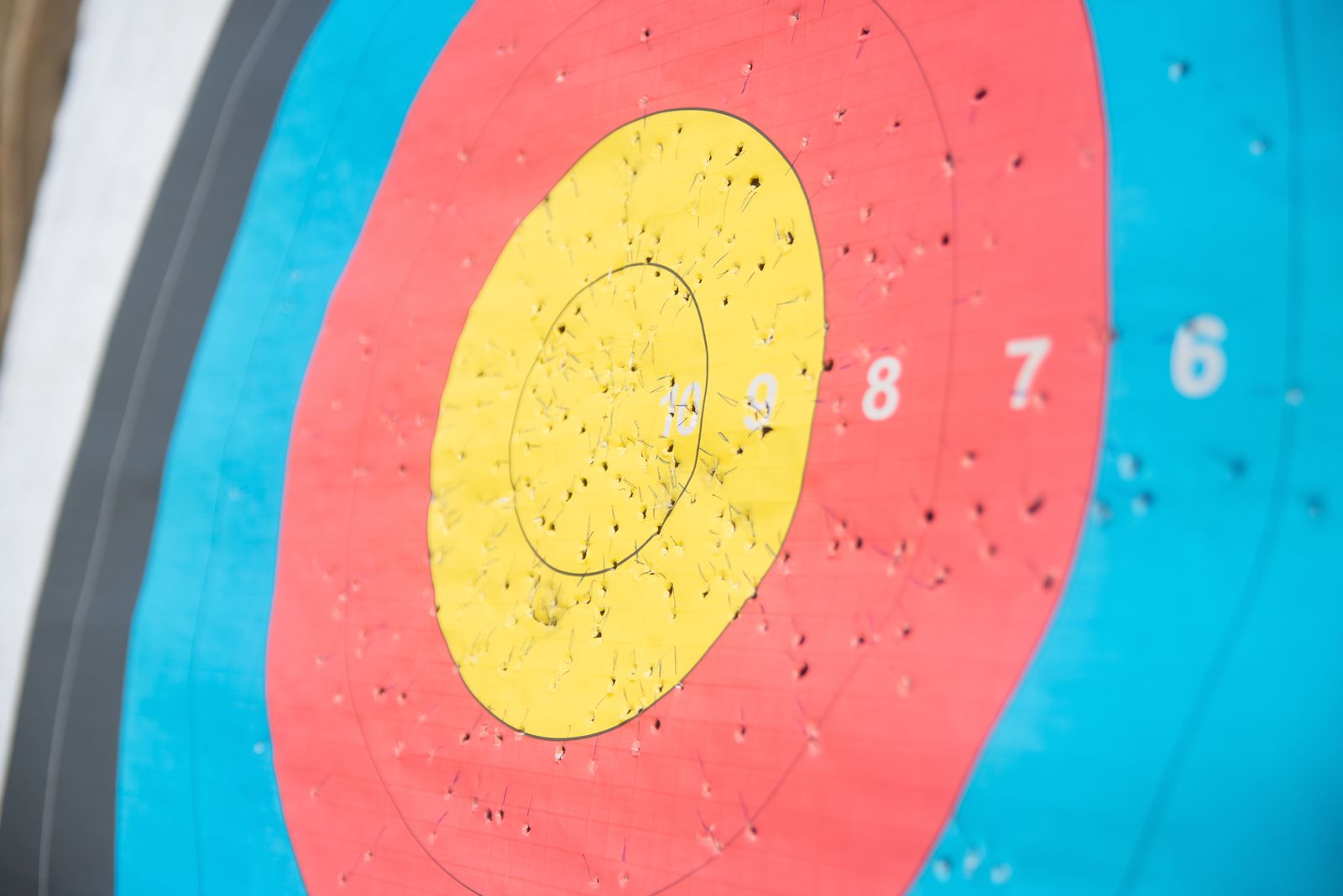
There is an elegant confirmation of all this, hidden in the target dimensions. The outdoor face shot at 70 metres is 122 centimetres wide; the indoor face at 18 metres is 40. Those are not random numbers: seen from the shooting line, the two faces have similar angular sizes, about one degree for the first, slightly more for the second. Whoever wrote the rulebooks made, in effect, the same argument this article makes: if the error is an angle, the target has to grow with distance too, or the game changes.
The interesting detail is in the centre, where the 10-ring of the 122 face measures 12.2 centimetres: at 70 metres that is about one tenth of a degree, exactly the angle in the earlier example. The indoor 10 measures 4 centimetres, which at 18 metres is about 0.13 degrees, so in angular terms it is actually a little more generous than the outdoor one. If you shoot excellent scores indoors and collapse at 70 metres more than you would expect, the first thing to ask is not what happens to your technique at long range, but what enters the game at 70 metres that was not there at 18: something really does enter.
The doubling rule
Here comes the diagnostic tool worth taking to the range: if the only cause at work were the angular error of the shot, doubling the distance should simply double the group, from 20 to 40 metres or from 30 to 60, and no more. When, by contrast, the group clearly grows beyond the ratio of the distances, it means something has joined in along the flight that was not there at launch: air, wind, or an arrow flying dirty because the tuning is off.
The third reading deserves an extra word, because it connects this article to reading impact patterns: the axes do not lie even when you change distance. A group that stretches horizontally as you move back is pointing at the horizontal plane of the system, release and tuning; one that stretches vertically questions the consistency of your draw length, your timing and your handling of the trajectory. Distance, in other words, does not change how the target is read, it only makes what was already there easier to see.
What the air adds
The group grows faster than proportion when more than the launch angle is involved: some causes disturb the arrow along its flight, and the longer the flight the more time they have to act.
The first is air resistance: the arrow slows down as it goes, so the final stretch of a long shot is flown more slowly than the first. The wind, as a result, does not push the arrow uniformly: it bites hardest exactly where the arrow is slowest and farthest from you, which is why drift grows more than proportionally with distance. On that front the group can only open, and asymmetrically with the gusts.
The second is the trajectory: an arrow's drop grows with the square of its flight time, so a small difference in speed from one arrow to the next, invisible at 18 metres, becomes a difference in arrival height at 70. This is the channel through which variability in your release and draw dresses up as "a vertical error that only shows up at long range". It did not show up: it was there before, it just never had the time to express itself.
Long distances expose the tuning
Finally there is the equipment chapter, and at long range it is merciless. An arrow whose spine does not match the system leaves the bow with an oscillation that is harder to damp, and every extra metre gives it time and road to pay the price. At 18 metres the fletching manages to mask almost everything; at 70 it does not. It is the same reason serious tuning is never judged at short range alone: the group test at competition distance exists for this.
The typical signal is a group that is honest at short range and opens horizontally at long range beyond what proportion would justify, sometimes with the odd arrow that always escapes to the same side. Before rewriting your technique, spend the half hour on a comparison between fletched arrows and a bare shaft: if the flaw lives there, no amount of practice will make it disappear.
Distance does not create errors: it magnifies them, and signs them.
Errors of the shot grow in proportion to the metres, whereas errors of air and tuning grow faster. That is why comparing two distances is a diagnosis: it tells you not just how much you miss, but where to go looking for the cause. It is the cheapest thermometer you own.
The two-distance test, in practice
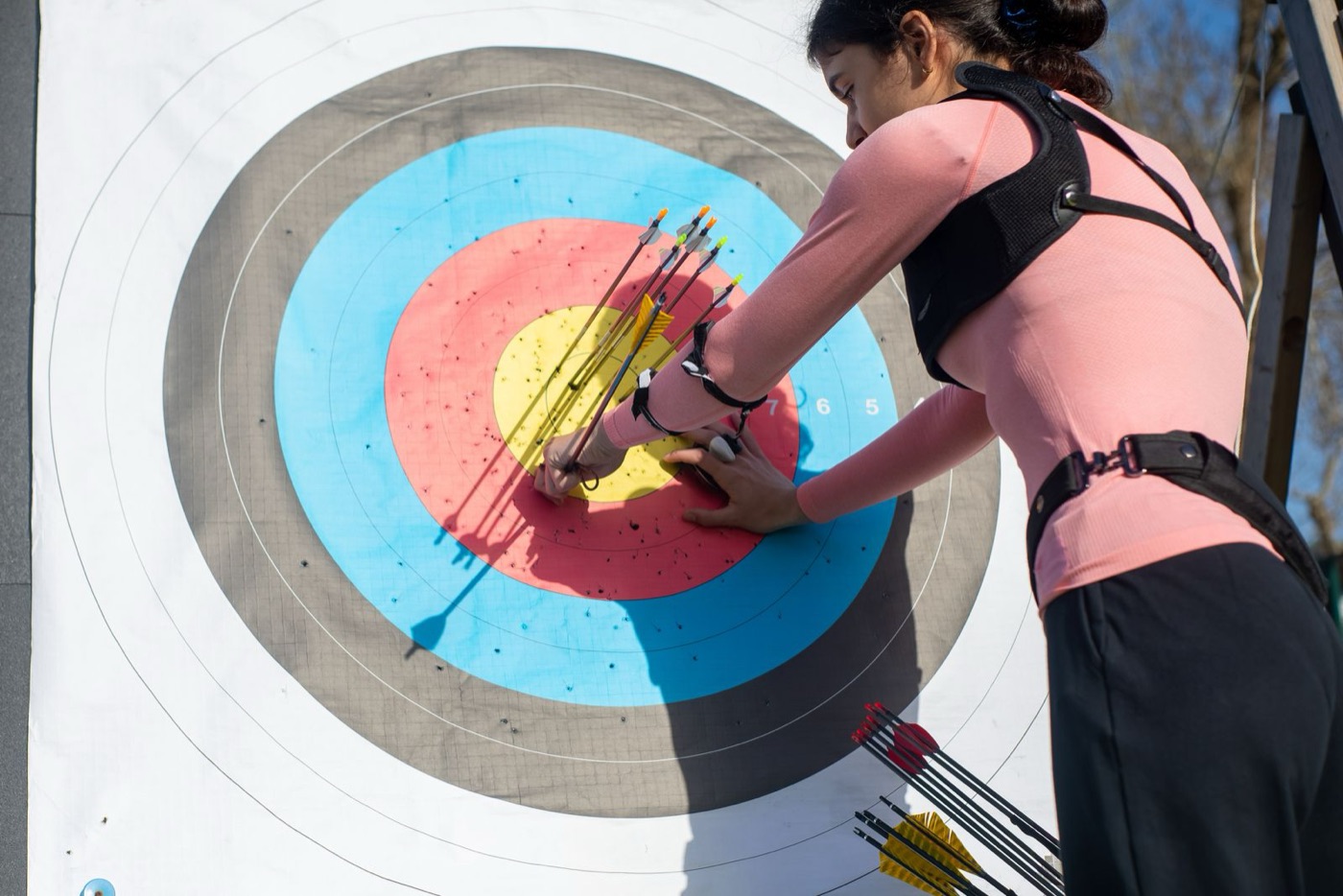
The procedure is simple, and it is worth doing properly once rather than by eye for months. Pick two distances with a convenient ratio, say 20 and 40 metres, or 30 and 60. Shoot a full series at the first, at least a dozen arrows, and measure the width of the group on both axes, horizontal and vertical, discarding at most one clearly called-out arrow. Repeat at the second distance, same series, same tape.
Then compare the two numbers. If the group is roughly double at double the distance, the workshop is the shot itself, and you can train at short range with a clear conscience; if it is far more than double, or clearly changes shape, go through the tuning and the wind before touching your technique. In both cases the usual rule applies, the same one as for reading impact patterns: change one thing at a time, then measure again.
One last warning, so the test does not become an alibi. Proportion is a compass, not a courtroom: no series of twelve arrows is a final verdict, and a windy day muddies any comparison. If the result looks strange, repeat the test on a calm day before drawing conclusions, because it is there to steer the weeks of work that follow rather than to settle the matter.
The questions I get asked most
Why does my group open up so much from 18 to 70 metres?
Partly it is pure geometry: for the same error, the miss on the target grows in proportion to the distance, so it nearly quadruples from 18 to 70. The rest is added by the air and the tuning: wind, drag, an arrow flying dirty. If your group grows well beyond the proportion, that is where to look.
How much should my group grow when I double the distance?
If the dominant cause is the shot, about double: angular error grows in a straight line with the metres. A group that is far more than double at double the distance signals that something is acting along the flight, and the first suspects are wind and tuning, not your technique.
Does a wide group at long distance mean my spine is wrong?
It can, but not on its own. The typical signal of a mismatched spine is a group that opens horizontally at long range beyond proportion, sometimes with arrows escaping always to the same side. The confirmation is not a feeling: it is the comparison between fletched arrows and a bare shaft.
What distance should I train at to tighten my group?
It depends on what you are training. Short range isolates the shot: more repetitions, fewer variables, clean feedback. Long range tests the complete system, tuning and air included. Alternating between them, knowing what each one measures, beats living on either alone.
Further reading. What you read here rests on the scientific literature and on official target dimensions. To keep the text light I do not cite individual studies, but you can find the full reference library, over 120 studies and texts, on the dedicated page.
Go to the bibliographySome things I take on directly.
I work on training and functional rehabilitation, on injury prevention and recovery, and on research. If you have a project or a collaboration in mind, or a question left over from what you have just read, write to me: I answer myself.